Stellenbosch · Western Cape
Bergkelder
Bergkelder is a wine farm in Stellenbosch, Western Cape. About 39 km from Cape Town.
Stellenbosch · Western Cape
Bergkelder is a wine farm in Stellenbosch, Western Cape. About 39 km from Cape Town.
Bergkelder — often styled Die Bergkelder — is one of Stellenbosch’s most important twentieth-century wine landmarks: an underground maturation cellar tunnelled into the slopes of Papegaaiberg on the edge of town. The Afrikaans name literally means “mountain cellar,” and the project was conceived as a cool, stable bottle-and-cask ageing environment carved into rock rather than built as a conventional surface winery. For decades it anchored premium brands linked to Stellenbosch Farmers Winery and later Distell, and it played a catalytic role in modernising Cape vineyard plantings and oak maturation. Visitors researching Bergkelder today need both the heritage story and a clear-eyed note on current public access.
Within Stellenbosch Valley coverage, Bergkelder is best understood as infrastructure and institution more than as a boutique family farm. It belongs on the map because it changed how the Cape thought about noble varieties, French oak and wine tourism — even if the walk-in tasting chapter has closed.
Die Bergkelder was established in 1967 under the Stellenbosch Farmers Winery orbit, with formal opening celebrated in November 1968. It was promoted as the first underground bottle-maturation cellar of its kind in the Southern Hemisphere — a bold piece of industrial design for a Cape industry then still shedding bulk-wine habits. The site sits beneath Papegaaiberg, the hill whose Dutch name recalls clay-pigeon (“papegaai”) shoots once held for Governor Simon van der Stel’s birthday celebrations in earlier centuries. A footpath culture around the Plankenburg River and landscaped approaches later framed the visitor journey to the “cellar in the mountain.”
Inside, thousands of bottles could rest in cool rock-lined galleries watched over by large French oak casks, some carved with Cape wine landmarks and historical scenes. That theatrical yet technical environment made Bergkelder a natural tourism draw as well as a working maturation facility. It also became a symbol of Stellenbosch’s mid-century ambition: wine as both industry and destination, minutes from the town centre rather than hours into a remote valley.
Bergkelder’s lasting industry influence runs deeper than tourism. Through the 1970s and into the tenure of cellarmaster Dr Julius Laszlo (associated especially with the late 1970s through early 1990s), the organisation encouraged growers to plant classic noble varieties — Chardonnay, Sauvignon Blanc, Cabernet Sauvignon, Cabernet Franc, Merlot and others — at a time when the Cape still leaned heavily on older bulk-oriented plantings. In 1979 Die Bergkelder took a leading role in maturing quality wine in small casks of new French oak, helping shift South African fine-wine culture toward international barrel practice.
Those choices rippled across Stellenbosch Valley and beyond. Brands that called Bergkelder home, notably Fleur du Cap (launched around 1968 alongside the cellar’s early years) and labels such as Stellenryck, carried the mountain-cellar story to retail shelves. The later Fleur du Cap Unfiltered range (associated with a late-1990s launch) extended the philosophy of minimal interference and varietal clarity. A signature blend later named in Laszlo’s honour underscored how strongly the cellar’s modern identity was tied to that cellarmaster’s era. Whether or not a given bottle was physically aged under Papegaaiberg, the Bergkelder name became shorthand for a more ambitious Cape quality project.
Corporate history matters here because Bergkelder was never a tiny family farm. Distillers Corporation — founded by Anton Rupert — had long used a “Bergkelder concept” that invited estates into shared bottling, sales and marketing networks. In December 2000, Stellenbosch Farmers Winery merged with Distillers Corporation to form Distell, headquartered in Stellenbosch. Distell’s wine and spirits portfolio made the Papegaaiberg cellar part of a much larger group infrastructure. In 2023 Distell’s wine and spirits businesses were absorbed into the Heineken Beverages South Africa structure following Heineken’s regional transactions — another ownership chapter for facilities and brands historically tied to Bergkelder and Fleur du Cap.
For SEO and travel writing, that lineage explains why Bergkelder appears in Distell-era guidebooks, Fleur du Cap brand stories and Stellenbosch town itineraries even when it does not behave like an independent boutique estate on the Wine Route map. Company registries still list Die Bergkelder as a long-standing private company linked to Stellenbosch addresses in the Distell / distillers estate — useful context for researchers, less useful for tourists seeking a tasting menu.
For many years Die Bergkelder Wine Centre offered cellar tours, tastings (including a once-popular salt-and-wine pairing with Fleur du Cap wines), a large retail shop and museum-like displays of historic wine equipment. Multiple recent travel and listing sources now flag the public visitor operation as permanently closed or no longer recommended. Hours once published (weekday and Saturday retail/tour patterns, closed Sundays) should not be trusted without fresh confirmation from Heineken Beverages / brand channels.
Practical advice: do not plan a Stellenbosch Valley day around a Bergkelder walk-in tasting until you verify current public access directly. Fleur du Cap and related wines remain available through retail and other brand experiences; the underground cellar’s tourism chapter appears, for now, to have ended even while the site retains historic and industrial significance. Treat Bergkelder primarily as heritage context for Papegaaiberg and Stellenbosch’s corporate wine history, then spend your tasting budget on open valley and mountain estates nearby.
Include Bergkelder in a Stellenbosch Valley farm index because it shaped how the Cape planted, matured and marketed fine wine in the late twentieth century. Few other “cellars” can claim a mountain tunnel, a pioneering French-oak programme and a brand incubator role under SFW/Distell in one narrative. Visit neighbouring Papegaaiberg and valley estates that are open today, drink Fleur du Cap if you want a living link to the mountain-cellar era, and remember Bergkelder as infrastructure and idea — the rock-cut proof that Stellenbosch once bet its future on noble varieties, serious oak and wines worth laying down underground.
All-day tasting at the Bergkelder Wine Centre of a selection of fine wines focusing on Fleur du Cap (and others). Historic cellar in the mountain on Papegaaiberg. Official bergkelder.co.za returned errors when checked 2026-09-07 — confirm offerings before visit.
Price Not currently published on an accessible official page Duration Not published
Booking: Phone +27 21 809 8025 / email info@bergkelder.co.za (directory listings); confirm still operating
Details on the farm website ↗Guided tours of the underground bottle-maturation cellars (Cellar in the Mountain), historically also covering wine museum / Vinoteque areas. Tour times commonly listed Mon-Fri 10:00, 11:00, 15:00; Sat 10:00, 11:00, 12:00. Current schedule and fees unverified on live official site (bergkelder.co.za error as of 2026-09-07).
Price Not currently published on an accessible official page Duration Not published
Booking: Bookings advisable (limited group size); +27 21 809 8025 / info@bergkelder.co.za
Details on the farm website ↗Wine list from wine.co.za. The taste words are drawn from those notes, which are not reprinted here. Ask the cellar door what is pouring on the day.
Bergkelder is at 43 George Blake St, Plankenbrug, Stellenbosch, 7600, South Africa. Most visitors drive there from Cape Town in 45–60 minutes.
Open Sunday. Hours change, so call 021 202 7567 before you drive.
Yes, tastings are listed. A current price is not on this page yet, so call 021 202 7567 for fees.
Geographical unit: Western Cape → Coastal Region → Stellenbosch
Stellenbosch is the flagship Wine of Origin district of the Cape: granite mountains, university town, and the densest cluster of visitor-ready wine farms in the country.
Elevation and soil figures are modelled at the pin, not a vineyard block survey. Use them to compare farms, not to quote a technical sheet.
Stellenbosch
KidsBudgetWheelchair access Tasting
Stellenbosch
Stellenbosch
Stellenbosch
KidsViewsWheelchair access Tasting Restaurant Stay
Stellenbosch
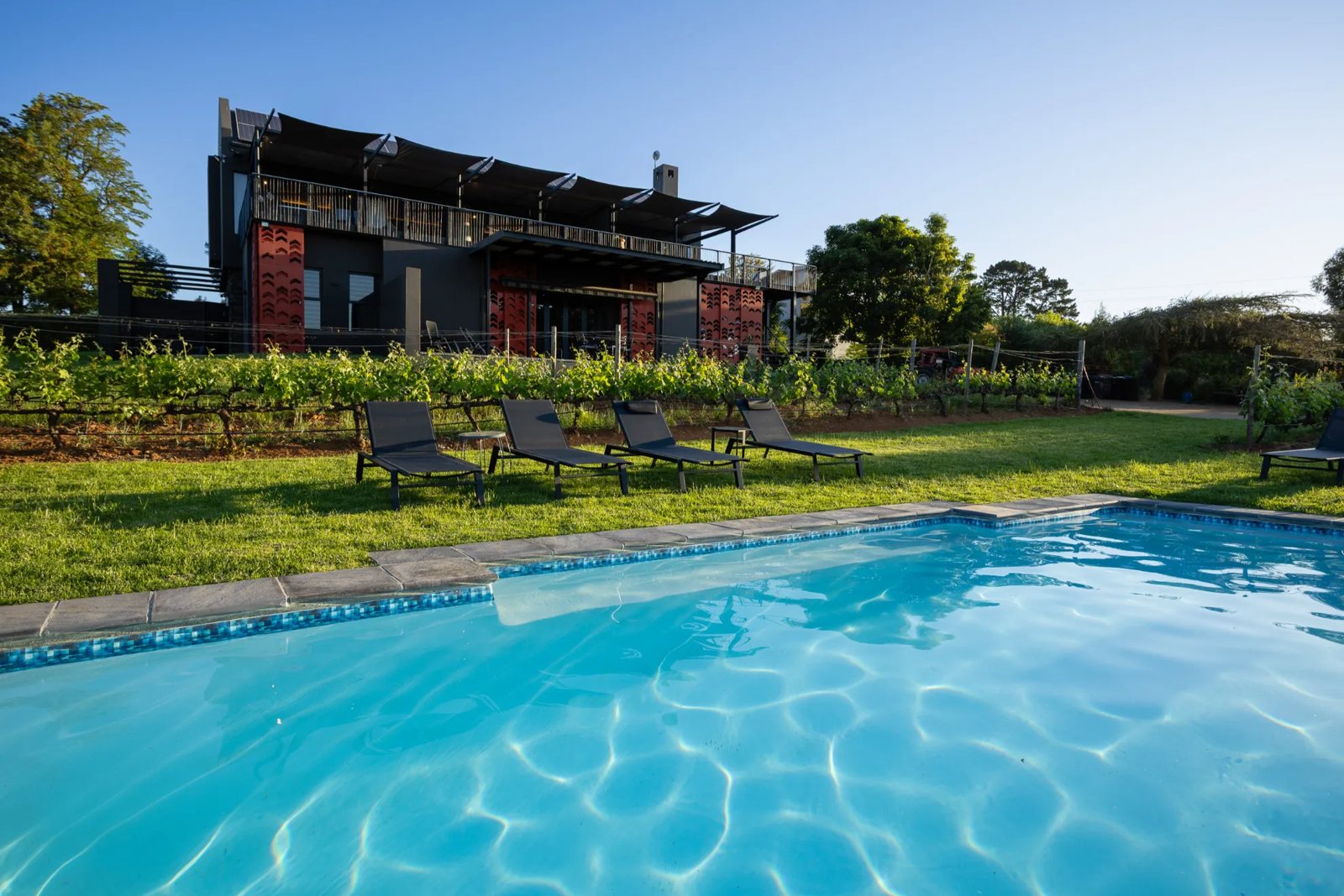
Kunjani Wines (also styled Kunjani Villas & Wines) is a boutique Stellenbosch wine estate in the Bottelary Hills near Devonvale, founded by Paul Barth and Pia Watermeyer.
Romantic Tasting Stay
Stellenbosch

Stellenbosch
Stellenbosch
KidsRomanticWheelchair access Tasting Restaurant Stay
Stellenbosch
Stellenbosch
Stellenbosch
Stellenbosch
Stellenbosch
Stellenbosch
KidsWheelchair access Tasting Restaurant